top of page
  • 1 min read

Updated: Sep 9, 2023


Leaving the city, I’m a gray cloud made of workday dust and the worry of being late. I crawl into the bus, because I missed the train, in the careless trample of a hundred feet trying to get away.


‘But, why?’


“Don’t ask why. Just keep moving,” the road tells me. I submit.


The city fades. Lines of windows flashing television screens get slowly replaced by dancing shadows of trees. Glimpses of paddies emerge earthly green, cast into temporary pools of yellow by the lamps dotting the streets. With that, I find that I’m healed—from the Monday-to-Friday, from the apathy of the herd. I’m reconciled with the world.


On the road, I’m reborn. I’m a bird taking off from the street wire to spread my wings over the holy mountain. The air is a song.


I’m home, long before home.


This story ‘Rebirth road’ was inspired by a work of mixed media art by the Sri Lankan artist Dhammika Perera. Dhammika’s hometown is by the tranquil inland hills and rivers of Sri Lanka with a view of the sacred Sripāda mount; he had to take a daily commute to Colombo for his day job as a teacher at the University of Visual Arts. Talking about those years spent in commute, Dhammika says he remembers the healing in the journey. The experience of growing past the city’s exhaustion with the changing landscapes stayed with Dhammika, inspiring him in the art studio of his village home. This original art is now available at the PW Store.


Updated: Apr 3, 2024


The murder of Richard de Zoysa was a turning point in the gruesome story of how the Sri Lankan government handled nationwide civil disobedience which grew into dangerous armed rebellion in the 1980s and early 1990s. Marking a dark period in the history of the sunny island, the official figures of the dead and the disappeared from this era cross 75,000 while it’s widely speculated to cross well into six figures. In this terrifying picture, Richard is one of the most visible figures. 


Belonging to a family of influential artists, educated at one of the most prestigious private schools in Colombo and a gifted poet, playwright and journalist, Richard had all the right networks and access. Like most people from his background, Richard could have remained above and beyond the chaos that ravaged the lives of rural and lower middle class youth in the island. Like many with connections abroad, he could’ve left as soon as possible. But, he didn’t. Well aware of his privilege, Richard de Zoysa used his education, talent and connections to speak about the injustices that gripped the lives of young Sri Lankans, the ugliness of strategically propagated racial tensions and the growing anger towards oppressive governance. His poetry, plays and writing resonated the significant mind shifts of the time, questioning the machinery at work to maintain the class and race gaps. He did this in a way that broke linguistic and ethnic barriers to extents that even more directly political figures could not. Of course, this charismatic, creative, and eloquent man with leftist leanings meant danger to many powers. 

Richard’s body was found on a beach, not too far from where he went to school as a child. It was discovered by a fisherman who recognised the face of this well-known actor. The records mention that it was beaten, broken, mutilated and shot at point blank. His mother and other eyewitnesses identified the abductors as high ranking police officers reporting directly to the President, making it one of the most strongly evidenced and widely publicised cases of rumoured government death squads. But, all identified suspects were never sentenced; instead, the leads were ignored by the police and the two main officers identified by eyewitnesses were allowed to walk free while two only got interdicted as punishment after the trial. None were even imprisoned. The two high ranking officers involved in Richard’s murder ended up dying in a bomb attack, along with the President, in an incident that many deemed karmic. Sri Lanka’s current President Ranil Wickremasinghe was one of the youngest ministers of the government at the time of Richard de Zoysa’s murder, and is said to have brushed off the death as ‘suicide or something else.’ 


Not failing to leave a mark even in his death, Richard triggered many significant milestones in the common citizen’s fight against a corrupt regime. Local and international media flooded with tributes, excerpts of his work and most importantly, questions that demanded answers. Time magazine published a piece on his death—that particular issue is still banned in Sri Lanka. The BBC did a tribute play for him many years later. Richard’s incredibly courageous mother—Dr. Manorani Sarvanamuttu— started the Mothers Front amidst death threats. It remains an active voice for families of the forcibly disappeared in the North and the South.


Richard's work—articles, plays, acting and writing remain, changing minds and telling the story of how people get played by governments to stay divided and fighting, for the benefit of a few. His poetry is particularly powerful; some pierce, shake, mock, and prophesy powers and their players as much as the played; others give views into his loves, encounters and lend us glimpses into intricacies of being a queer human in a conservative society. 


This book is a small volume of poems by Richard de Zoysa. It’s a treasured part of our library, reminding how even the most difficult questions can be asked with beauty, grace and wit. It’s an essential collection that carries the very essence of Richard; his daring to ask the hard questions, the strength to remain someone that isn’t the expectation, and most importantly, the beauty of being a human who loves the world and embraces all its experiences—the terrible and the blessed. 


Every month, we bring a new book access. Newsletter subscribers get to access a chosen publication from our archive of vintage books. We share the cover, a few selected spreads and the content page of interesting books. Subscribers can request for sectional scans for personal reading and research purposes.


When we started ideating a wearable merch series for Public Works, we wanted to make something that sparks curiosity, prompts questions about what we do and calls for storytelling. Why? Because merchandise that gets people curious and triggers conversation are perfect to get them connecting with our brand in a meaningful way. Besides, stories are one of the most wonderful ways to share information and enjoy creative expression with another person. We also wanted to make our merchandise highly consumable, timeless product types that people of many generations can relate to across different cultures; This is why we decided to design Public Works merch around the most ubiquitous clothing item of our times—the T-shirt. And of course, it couldn’t be that standard logo on the T-shirt. Our brief to ourselves was to make it something that makes people curious about what Public Works does.


Just as we tell our clients, we started with the brand values. Public Works being a company with creative thinking at its core, we wanted to make merchandise that reflected this imaginative spirit through an interesting story. To trigger questions about what we do, we looked into our work process for a good story seed. This is how we ended up designing a T-shirt series portraying iconic personalities that represent Public Works’ primary brand personality archetype—the creator archetype.


An archetype is a prototype or a model; a primitive ‘type’ inherited from the earliest human ancestors and supposed to be present in the collective unconscious according to a psychoanalytic theory put forward by Carl Jung. At Public Works, we use these Jungian archetypes in our storytelling process for typifying brand personalities and projecting their values in stories.


We use Carl Jung’s archetypes as a way to model a brand personality that reflects the real values and beliefs of a business. Among these Jungian prototypes of the human psyche, the creator archetype is one of most interesting. This is the personality that wants to contribute to the world through its creativity—a trait that companies connected to innovation, imagination and ingenuity often want to associate with through their stories. We’ve constructed many stories for businesses that embody this archetype. The creator archetype is special to us as a business because it’s one of the two primary archetypes shaping Public Works.


When Carl Jung identified the creator archetype first, it was coined as ‘the artist’. We prefer to use the term ‘creator’ as it includes the whole spectrum of creative minds. “Who looks outside and dreams; who looks inside and awakes”, Jung wrote, explaining the way the creative minds work.


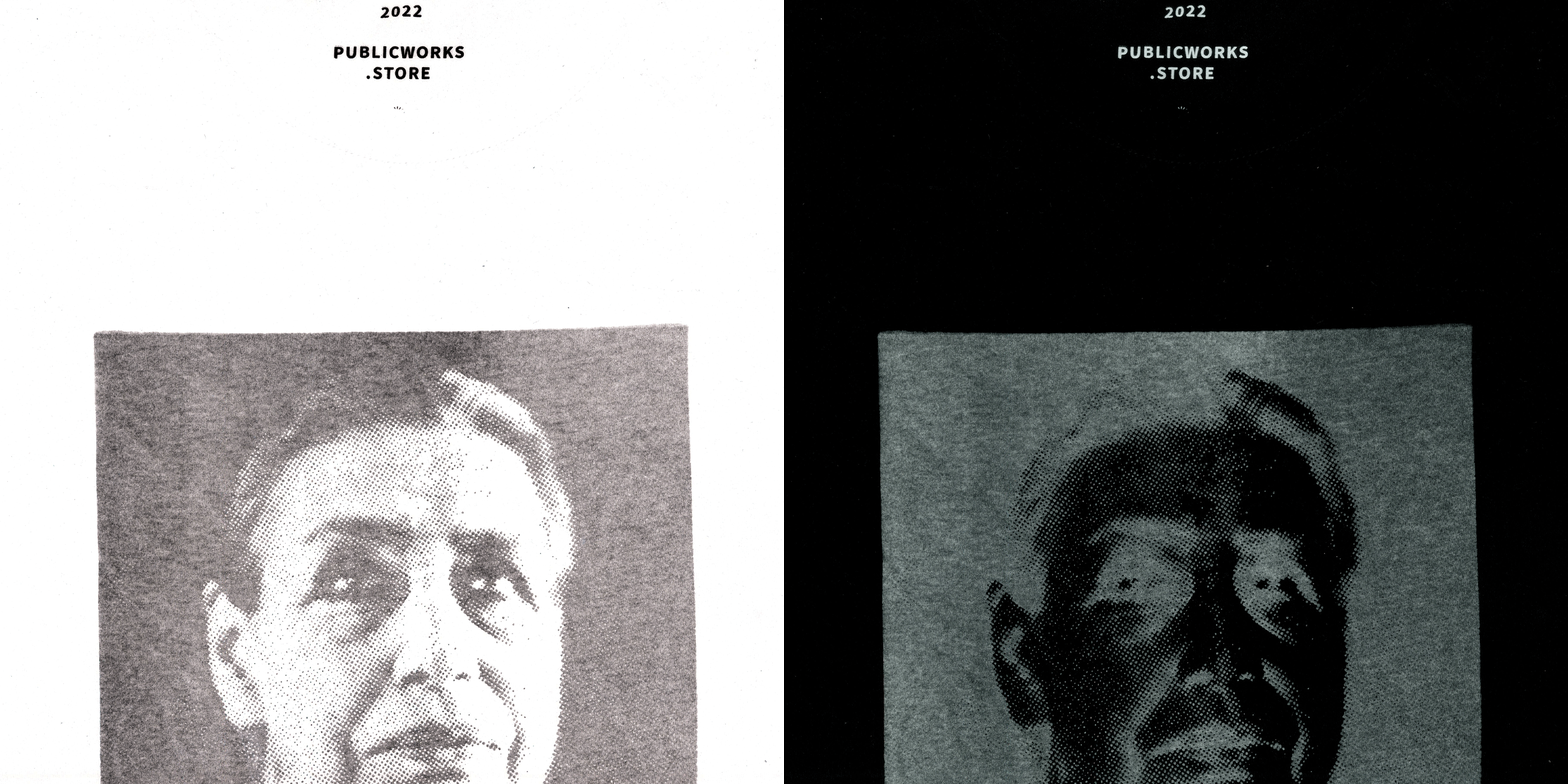
The T-shirt series we produced depicted three iconic creators who represented the power of the human imagination. Screen-printed entirely by hand, this limited edition T-shirt series featured the extraordinary woman Mirra Alfassa who created Auroville, Nobel laureate poet Rabindranath Tagore and, of course, the psychoanalyst that dared to tread the line between scientist and artist—Carl Jung.


This T-shirt series triggered many conversations and people were curious to learn more about these personalities and what stands out about their creativity; Through that, they connected with Public Works at a more profound level with shared values like imagination and innovation, instead of just seeing our company name and logo. It’s equivalent to remembering a person through a deep and meaningful conversation and not just as a face with a name.


We now use this series to show our clients how branded merchandise can be much more interesting than just a T-shirt with a logo. Great merchandise uses elements, ideas, events or people that connect the consumers to the core of a brand; they have greater potential to create more conversation that connects to the values of a business.


We think there’s always room to bring good storytelling into branded merch. If you’re thinking about getting merchandise that tells your brand’s story in a more imaginative way, ask us how.


bottom of page