top of page

A recipe for contentment revealed through an unintentional master


Growing up, the adult attitude toward work that surrounded me was that it was a tedious penalty for being financially able. Work was simply an exchange: money for energy. Unless you had a trust fund, it was a universal rule; you worked if you wanted to pay bills. No escape. I absorbed that culture and spent my early twenties preparing for careers that promised a nice paycheck at the end of the month, regardless of how I felt about the work itself. And I got one. It seemed simple enough until I encountered a simpler exchange that not only made life more bearable but also rendered it meaningful.
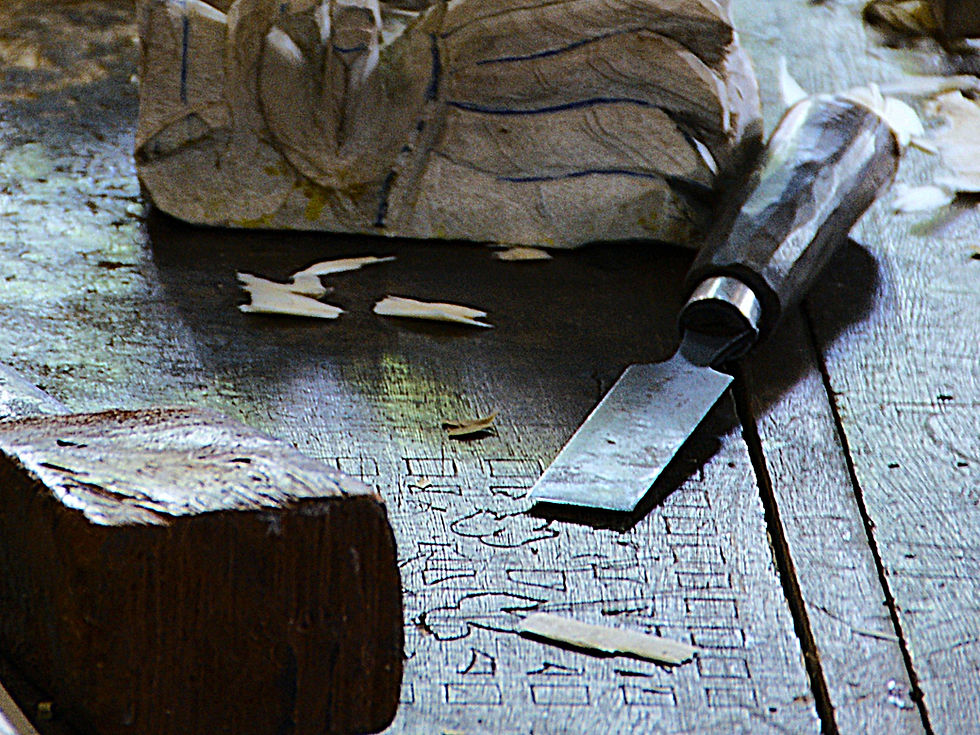

It is when work and worship are in the same stream. Image: Dan Arndt, 2018, Ambalangoda mask maker

My first glimpse into how work and worship could be the same stream came through a master mask maker in Ambalangoda, Sri Lanka. What struck me first was how disgruntled he seemed to have customers. We had interrupted his work, which he clearly loved to immerse in. There seemed to be something greater in his craft than the prospect of money. When I asked why he chose to become a mask maker, he simply said he had taken to it after watching his uncle carve masks; the act called to him. There was no grand scheme or career strategy. It was pure interest. My questions about how he learned the craft or shaped his process seemed to puzzle him. “You just do it, there is nothing else to it,” he said.


The master was not a financially affluent man. He earned what he could from visitors buying masks, occasional commissions, and the odd state-sponsored grant or award. His workshop was simple, his clothes even simpler. He wasn’t working on a major commission, but he was carving another spectacular mask to exhibit at Shilpa, the state craft exhibition, the following year. Compared to Colombo’s ‘successful’ artists, he seemed uninterested in visibility, interviews, or recognition. What he carried instead was an air of rare contentment. He had neither great luxury nor widespread fame. Even I, writing about him some years later, can’t remember his name. But what does that matter?


Because I remember how the master was deeply immersed in his work. Its reception was of no great consequence to him. Its legacy was irrelevant. His masks were an act of devotion to the relationship he had with his surroundings, perhaps even with his materials. They arose from his curiosity towards an act and his compulsion to converse with it, on terms that were strictly his own. I couldn’t imagine a higher form of creative contentment. For him, work itself was worship.


The master was not interested in teaching me. But he did, nevertheless. He showed me that the gap we assume between work and worship is not natural. The two can be the same. And lives lived in that unity, I believe with good reason, are blessed with a rare sense of contentment.


Worship isn’t only in temples, churches, or mosques; it’s in the act of being deeply there for something. Worship is not a place, but a quality of presence. Worship isn’t in ritual alone, but in how we show up to the world. When someone is fully present in their task—whether sweeping a floor, weaving, coding, or painting—there is reverence in that presence.


I don’t know what became of the master mask maker. Perhaps he still shapes wood into faces with stories. Perhaps he died content in the act of doing so. Either way, he left me with an insight that shifted my own course. I stopped trying to fit into careers that looked good on paper and instead turned to the messy path of becoming a commercial creator to fund my personal creativity. When my son asks me what he should become when he grows up, I tell him to find where he naturally loses himself; to look for acts that draw him with curiosity, to immerse himself; to find worship in life.


Now, I know for certain that work is best as a form of worship. And more often than we realize, worship is the better exchange with the world; one that sustains meaning and pays the bills.


A personal story from PW co-creator, Shamalee

The other week, when we were wrapping up an intense period leading up to travel overseas, I couldn't proofread a story that my partner published for our studio newsletter, and it went out with a grammatical error. Now, this was not the first time our studio has made a little mistake, but seeing it on my screen still brought up a bad taste at the back of my throat. Unlike all the previous times, when I would torture myself and question my credibility as a writer, the bad taste subsided almost immediately, because the calm voice in my head said, “Well, it leaves no doubt that this newsletter is written by humans and not AI.”


This got me thinking about how creators will most likely start seeing errors or other slips in perfection more as a hallmark of the humanness in their work, and less as embarrassing things to camouflage. It’s not just when it comes to mistakes; it’s interesting to consider how AI—or the perception of it—will influence creativity around the idea of ‘perfection.’


Just a few weeks ago, I read how the em dash—probably my favourite punctuation mark, because I like to introduce offshoots of ideas into sentences—is starting to get the reputation as a sign of AI writing. And it’s not entirely unfounded; ChatGPT seems to have a habitual devotion to the em dash, giving unnecessary significance to pauses and breaks in common sentences. Because of this, I found myself consciously holding back on the em dash, forcing myself not to bring my layered thoughts into sentences. Soon enough, I realized that I was compromising my mind’s mechanism just to distance my work from what’s perceived as a sign of AI-generated creativity. As much as we are used to prototyping and shaping AI, it will also undoubtedly shape us—the way we create, and our distinction of what makes our creativity ‘human.’


I recently visited my old university at the invitation to critique an undergraduate project on designing stories for Sri Lankan cities in predominantly visual aspects, with some written language components. Here, I became highly aware of how I judge the value of creative work against what I consider to be genuine human creative output versus AI-generated. In 70% of the work presented, the written components of the story, such as slogans and promotional texts, reeked of ChatGPT. And I’m not talking about sentence structure or an overuse of the em dash. Although I couldn’t put a finger on what was so distinctly ChatGPT about those works at the time, now I can. It’s best explained as “saying a lot without saying anything”: words that are strung together to create a sense of (subjective) beauty, but utterly hollow of lived experience and a viewpoint. They are not directional. Words that have logical and even aesthetic coherence, but don’t communicate a point of view in an idea; that have the micro-connections, and the many emotional and sensory associations that we humans make with things in our mind and things we perceive in the outer world. They lacked the many dimensions that seep into the writing of a human who has genuinely experienced the subject. For those students, I didn’t think mediocre writing posed a great threat, particularly because their course was more focused on the visual elements of storytelling. However, I was concerned that they were missing out on the accidental wonder of creativity by using ChatGPT for creative writing.


An idea is not limited to one form of expression; the same idea has many forms, such as visual, linguistic, sonic, etc. When you approach an idea from many directions, your view of it becomes richer and more distinct. As a design student many years ago, I discovered the joy of writing simply through attempts to describe ideas as best as possible. Although my projects were not being marked for writing per se, my attempt to use language to articulate an idea gave me a different hold on it—something more concrete and definitive that visuals didn’t deliver. Ultimately, it led me to a career focusing more on writing designed for commercial outcomes. But I wondered if the students who used ChatGPT for their project writing were missing out on the chance to get a different grip on their idea—or even a breakthrough into an entirely different career path in creativity. I don’t know; too soon to tell. Who am I to judge? Each to their own life and times, isn’t it?


I’m not against AI; in fact, I think it has the potential to rid us of meaningless or tedious tasks. I use a trained version of ChatGPT to draft emails, formal letters to the city council, project proposals, notes to the lawyer, follow-ups, lists… things that I don’t care to excel at. But when it comes to creative writing, AI is more of a technical assistant than a substitute: to cross-check whether a new story contradicts an old one in a series; to proofread and grammar-check drafts. I look forward to the day when AI can do everything I don’t want to do: filing taxes, laundry, groceries, bookkeeping, managing employees—even if it’s at the cost of another machine having an enormous influence on my life. Anything to escape doing chores so I can read and write more, really.


Until then, I just have to watch how the world evolves, understand our parts in shaping it, and hold on to what I like about being human a little closer.

Two instances when the mango tree became iconic in Sri Lanka’s stories


In Sri Lanka, myths, faiths and histories are often woven around some kind of tree. From sagely Banyans, serene Bo’s to Neems and Jaks that bridge to the netherworlds, trees have often been made into icons and symbols of ideas close to local culture.


Among them, the mango tree appears again and again—not as a sacred shade, but as a witness. To sermons. To ships. To the tides of transformation.


ree
Local artists and craftspeople depicted mango trees in art, wall paintings, and jewelry, as well as motifs on textile borders.

One of the oldest stories begins in Mihintale, Along the hundreds of granite steps that climb toward Mihintale, mango trees still grow where they were iconised as witnesses to a historical philosophical exchange between a monk and a king.


You see the mango forest periphery along the stone stairways going up the now sacred rock—rooted in granite, branches reaching across the old sky, offering brief shade to pilgrims and wild monkeys alike. It does not announce itself; but the mango forest has always been here.


Mihintale is where King Devanampiyatissa met Arahat Mihindu—emissary of Emperor Ashoka, monk, teacher—and was asked to think, before he was asked to believe. The two men, at two extreme poles of secular and spiritual paths, met through an intellectual exchange.


According to Sri Lankan chronicles, it was in a mango grove on this very hill that Mihindu Thero posed a series of riddles to the king to assess his capacity for logic, reflection, and comprehension—the tools necessary to receive Buddhist philosophy. The King passed. The exchange marked the formal arrival of Buddhism on the island.


And the mango forest became a witness.


That mango forest is not remembered in marble or bronze, but the living forest itself. Its presence here was never ornamental. The trees bore fruit, gave shade, and anchored one of the most important philosophical encounters in Sri Lankan memory. And so they were left alone.


To this day, the mango forest of Mihintale remains.


Its canopies have sheltered centuries of thought. Its cycles of fruiting and falling have marked time outside the calendar. And in June, as pilgrims ascend those stairs for Poson Poya, it is not only the shrine they come to honour—but the path itself, lined by the forest that once overheard a new way of thinking take root.


The mango forest is still part of that rhythm. Quiet. Bearing witness. Offering stories to the ones who remember to look up.


The young leaves of mangoes take shades between tender orange and deep brown. Then, they grow into a vivid green before maturing into deep green. Areas like Mihintale in Sri Lanka, where mangoes grow in large groves, and are left untouched due to their historical significance, the tree tops take on colours from orange, brown, and vivid green to sombre green.


Another historic story took shape under a mango tree.


The origin of Colombo’s name, according to one etymological thread, points to a mango tree that never bore fruit. Kola-amba—meaning ‘leafy mango’—described a great mango tree near the mouth of the Kelani River. Vast and evergreen, yet never yielding fruit, the tree became a marker for seafarers for its sheer size. Kolamba thota—the port of the leafy mango—eventually became Colombo. To be named after a tree that offered no mangoes, yet remembered by every ship tracing the routes to riches; quite fitting for a city that barely a few can call home, but so many reside in.


ree
Mangoes were among the most commonly documented trees by early visitors to Sri Lanka. 1656, the mankó, Michał Boym

The mango tree marks both a spiritual turning point of a nation and its colonial threshold. Trees do not pick sides, after all. They hold memory, not judgment. And in their shade—where faith began, where names were made—we are reminded how trees hold the stories of who we are, and where we’ve been.

bottom of page